Spine Procedures
Epidural Steroid Injections
An epidural steroid injection places anti-inflammatory steroid into the epidural space around an irritated spinal nerve. It is used for radiating leg or arm pain from a herniated disc or stenosis. Most patients feel relief within two to seven days, and relief commonly lasts three to six months. Results vary.
Medically reviewed by Ramya Rangaraj, MD — ABPMR, ABPM
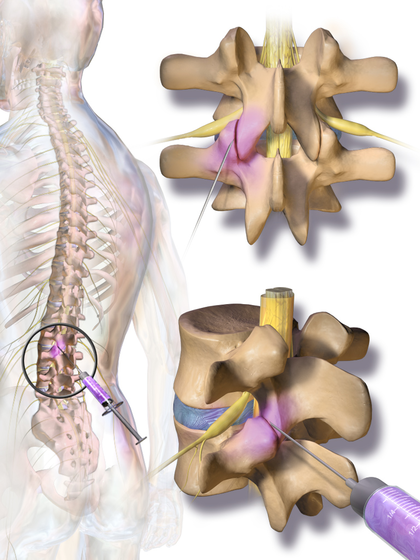
What the injection does
When a disc bulges or the spinal canal narrows, the nerve root leaving your spine gets compressed and inflamed. That inflammation is what sends pain, burning or numbness down a leg or an arm — often worse than the back pain itself.
An epidural steroid injection delivers a corticosteroid directly into the epidural space next to that nerve root, along with a small amount of local anesthetic. The steroid reduces the swelling around the nerve. It does not fix the disc, and it is not a cure for arthritis. What it does is quiet the inflammation so the nerve can settle down and you can move, sleep and complete physical therapy.
Dr. Rangaraj uses live fluoroscopy — real-time X-ray — with contrast dye to confirm the needle is exactly where it should be before any medication is given. Injections done without image guidance are less accurate, and accuracy is the difference between relief and a wasted procedure.
Who it helps
- Sciatica: pain running from the low back into the buttock, thigh or calf
- Lumbar or cervical herniated disc with radiating pain
- Spinal stenosis with leg heaviness or cramping when you walk
- Radiculopathy after a car accident or lifting injury
- Pain that has not responded to six or more weeks of conservative care
What happens the day of the procedure
You will lie face down (or seated for a cervical injection) on the procedure table. The skin is cleaned and numbed with lidocaine. Under fluoroscopy, a thin needle is advanced to the epidural space, contrast confirms correct placement, then the steroid and anesthetic are injected.
The injection itself takes a few minutes. Plan on roughly 45 minutes to an hour in the office, start to finish, including check-in and a short observation period afterward.
The local anesthetic often makes the leg feel better within an hour. That effect wears off the same day — this is normal and is not a failure of the procedure. The steroid takes two to seven days to work.
Recovery and what to expect after
- Most people drive themselves home if they did not have sedation. Arrange a driver if you choose sedation.
- Take it easy for the rest of the day. No heavy lifting, no strenuous work.
- Soreness at the injection site for a day or two is common. Ice helps.
- Return to normal activity the next day unless told otherwise.
- We schedule a follow-up in two to four weeks to measure the result before deciding on next steps.
How many injections, and what comes next
There is no fixed series. If the first injection gives meaningful relief, a repeat may be reasonable when the effect fades, generally spaced at least a few months apart and limited over a year to protect against steroid side effects.
If two well-placed injections do not help, we stop and reconsider the diagnosis rather than repeating something that is not working. That may mean advanced imaging, a diagnostic block of a different structure, radiofrequency ablation, or a surgical opinion. The point of the procedure is information as well as relief.
Risks
Epidural steroid injections are low-risk when performed with image guidance, but no procedure is risk-free. Possible effects include temporary increase in pain, headache, a short-term rise in blood sugar in diabetics, facial flushing, trouble sleeping for a night or two, and rarely bleeding, infection or nerve irritation.
Tell us before your appointment if you take blood thinners, have an active infection, are pregnant, or have poorly controlled diabetes. Some of these mean rescheduling rather than cancelling.
How the visit works
What to expect
- 01
Consultation with Dr. Rangaraj
You see the physician, not a rotating provider. She reviews your history, examines you, and goes over any imaging you already have.
- 02
A plan you agree to
If a procedure makes sense, you hear what it targets, what it typically does, and what it will cost you before anything is scheduled.
- 03
Procedure day in our office
Procedures are performed in our own suite. There is no hospital admission and no separate facility fee on your bill.
- 04
Follow-up and next steps
We measure the result at a follow-up visit. If something is not working, we reconsider the diagnosis rather than repeat it.